Çalışma Saatlerimiz
Hafta içi: 09:30–20:00
Cumartesi: 09:30–20:00
Pazar: Kapalı
Working Hours
Weekdays: 09:30–20:00
Saturday: 09:30–20:00
Sunday: Closed
Successful dental implant planning involves more than identifying a gap in your smile. Your dentist also needs to understand the three-dimensional anatomy of your jaw. Cone beam computed tomography (CBCT) can help assess bone dimensions, nearby nerves and sinus anatomy before implant surgery. So when is a 3D scan useful, and what should patients expect?
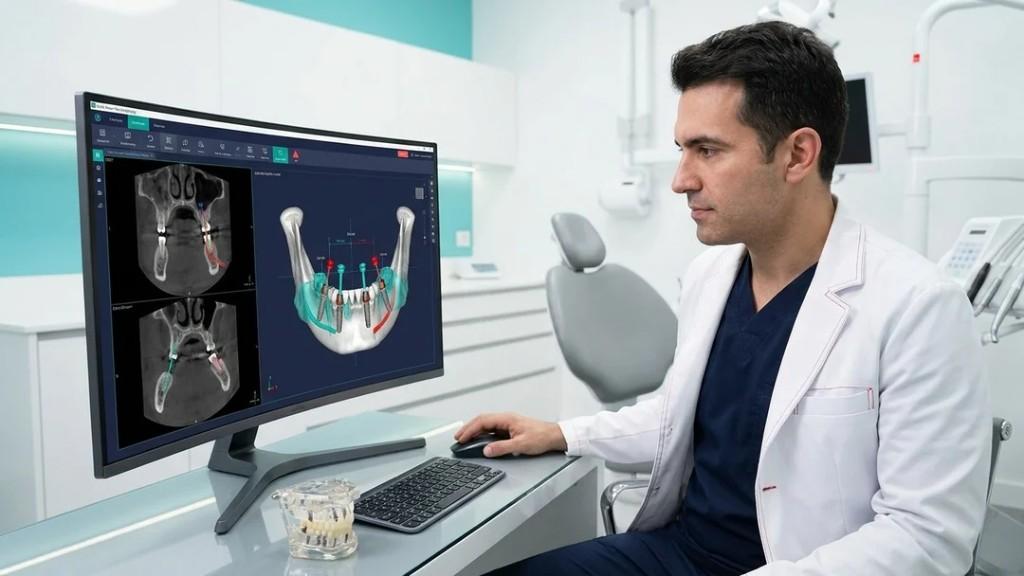
CBCT is a dental imaging technique that creates three-dimensional views of teeth and jaw structures. A panoramic X-ray provides a broad two-dimensional overview. By contrast, CBCT allows clinicians to review cross-sectional images of the proposed implant site.
The scan does not replace a clinical examination. Your dentist considers your medical history, oral examination and existing images before deciding whether additional imaging is needed.
CBCT helps clinicians evaluate the width and height of bone where an implant may be placed. This can inform decisions about potential implant dimensions and whether additional treatment, such as bone augmentation, should be considered.
In the lower jaw, the inferior alveolar nerve canal needs careful consideration. In the upper back jaw, the maxillary sinus can influence the available implant space. Three-dimensional imaging helps the dentist assess these relationships.
Implant positioning should account for the future crown or bridge, bite function and the ability to clean around the restoration. Digital planning software and surgical guides may be used when appropriate, but they are not necessary for every case.
When bone volume is limited, imaging can help evaluate whether augmentation may be appropriate. In upper posterior implant sites, sinus anatomy can be particularly relevant. A scan does not mean a bone graft will automatically be required.
| Feature | Panoramic X-ray | Dental CBCT |
|---|---|---|
| View | Two-dimensional overview | Three-dimensional cross-sections |
| Implant assessment | Useful as an initial overview | Helps assess bone width and anatomical relationships |
| Radiation | Generally lower dose | Varies by protocol; often higher than a panoramic image |
| When used | Based on clinical need | When justified for the diagnostic or surgical question |
More imaging does not automatically mean better care. The most suitable examination depends on the information needed.
Professional recommendations support CBCT for three-dimensional assessment when planning dental implant surgery. Nevertheless, imaging must be justified for the individual patient, with consideration of available scans and radiation exposure. When CBCT is appropriate, the team should use a suitably limited field of view and an optimised scanning protocol.
Tell the dental team if you may be pregnant or have recently undergone dental imaging, and share any available scans when possible.
The exact process and scan duration vary by equipment and clinical protocol.
At Dentadent in Bakırköy, Istanbul, implant assessment combines clinical examination, medical history and imaging when indicated. Learn about our oral diagnosis and radiology services and our dental implant treatment.
Patients travelling from the UK or elsewhere can discuss existing dental records with the clinic before their visit. However, an online consultation cannot confirm implant suitability without the necessary clinical assessment. For enquiries, visit our contact page.
The dentist determines what imaging is appropriate. Three-dimensional evaluation is recommended for presurgical implant planning, but decisions should take account of the clinical findings and available records.
The imaging procedure itself is generally painless. You will be asked to remain still during the scan.
Not necessarily. Depending on the findings, your clinician may consider bone augmentation or alternative approaches.
No. Imaging supports treatment planning but cannot guarantee an outcome. Healing, oral health, anatomy, surgical treatment and long-term care all matter.
No. Routine follow-up for implants without symptoms commonly relies on clinical examination and, when indicated, two-dimensional radiographs. CBCT may be considered for specific complications.
