Çalışma Saatlerimiz
Hafta içi: 09:30–20:00
Cumartesi: 09:30–20:00
Pazar: Kapalı
Working Hours
Weekdays: 09:30–20:00
Saturday: 09:30–20:00
Sunday: Closed
When you are missing a tooth, two common fixed replacement options are a dental implant and a dental bridge. Both can restore the appearance of your smile and help you chew, but they differ in how they are supported, how they affect nearby teeth, and what treatment and maintenance involve.
Dental implants vs bridges: which is better? There is no single answer for everyone. The most appropriate choice depends on the condition of the neighbouring teeth, jawbone and gums, your medical history, the position of the missing tooth, and your personal preferences.
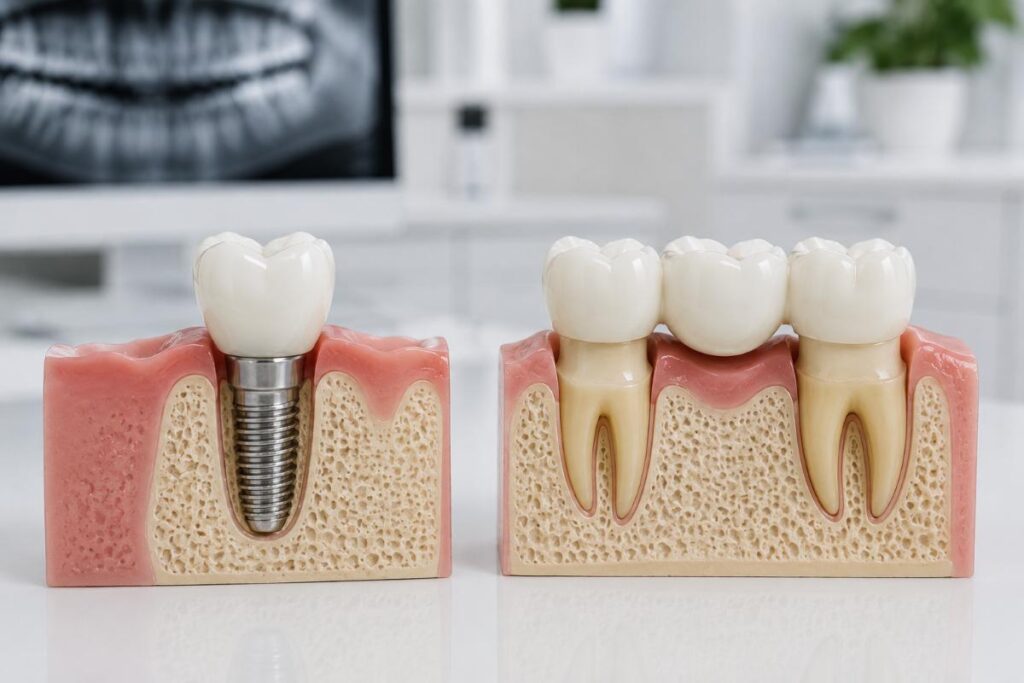
A dental implant is a fixture placed into the jawbone to support a replacement tooth. Following a suitable healing period, a connector and crown can be attached. For an isolated missing tooth, an implant may allow the space to be restored without preparing otherwise healthy adjacent teeth for crowns.
Read more about examination and planning on our dental implant treatment in Istanbul page.
A conventional fixed dental bridge replaces a missing tooth with an artificial tooth attached to restorations on one or more neighbouring teeth. Those supporting teeth usually need to be prepared. In selected cases, a resin-bonded bridge may offer a more conservative alternative, particularly for certain front-tooth situations.
| Consideration | Dental implant | Conventional fixed bridge |
|---|---|---|
| Support | Supported by a fixture within the jawbone. | Supported by adjacent natural teeth. |
| Neighbouring teeth | Often avoids reshaping healthy adjacent teeth. | Usually requires preparation of supporting teeth. |
| Procedure | Requires surgical placement and healing. | Usually does not require implant surgery. |
| Bone assessment | Suitable bone and overall health must be assessed. | Does not require placing a fixture into the jawbone. |
| Cleaning | Implant and surrounding gum tissue need thorough care. | The area underneath the replacement tooth needs special cleaning. |
| Planning | Based on clinical and radiographic assessment. | Depends heavily on the condition of supporting teeth and bite. |
An implant may be worth discussing when a single tooth is missing and the teeth on either side are healthy. Avoiding unnecessary preparation of those teeth can be an important benefit. However, bone volume, gum health, oral hygiene, smoking, relevant medical conditions and medications must be considered.
Some patients require additional treatment, such as bone grafting. Implant treatment also involves surgery and a healing phase; it is not automatically suitable for every patient.
A bridge may be appropriate when neighbouring teeth already have large restorations or need crowns, or when implant surgery is not preferred or is not clinically suitable. The supporting teeth must be assessed carefully for decay, gum disease, root health and the forces they will need to withstand.
For some missing front teeth, an adhesive or resin-bonded bridge may also be discussed. The choice depends on bite, available enamel and other clinical factors.
A conventional bridge can often be completed sooner because it generally does not require an implant to heal and integrate with bone. Implant treatment may involve several appointments and a healing period before the final crown is fitted. The exact timing varies by patient and treatment plan.
Neither option is maintenance-free. Daily brushing, cleaning between teeth and regular dental reviews remain essential. A bridge requires cleaning beneath the replacement tooth, often with floss threaders or suitable interdental aids. Implants require careful cleaning around the crown and gum line to help protect the supporting tissues.
Bruxism, smoking, periodontal disease and inconsistent maintenance may affect the long-term outlook of either restoration. No fixed replacement should be described as guaranteed to last for life without complications.
Both implants and bridges can function for many years, but their longevity varies. There is no meaningful universal winner based only on a single lifespan figure. The health of supporting teeth or bone, the quality of planning, the bite and ongoing oral care all matter. Sometimes a bridge needs repair or replacement; implants and their crowns can also develop biological or mechanical complications.
A dentist will examine the missing-tooth space, neighbouring teeth, gums and bite, and may recommend radiographic imaging. You can then discuss the potential benefits, limitations, number of visits, expected maintenance and suitable alternatives.
For patients visiting Istanbul from abroad, it is particularly important to understand whether an implant plan involves healing time or more than one visit. A treatment plan should be established after clinical assessment rather than from photographs alone.
Dentadent is based in Bakırköy, Istanbul. To ask about an assessment and the treatment-planning process, visit our contact page.
A single-tooth implant generally does not require reshaping the adjacent teeth for support. As with any procedure, suitability and possible risks need individual assessment.
Conventional bridges usually require preparation of the supporting teeth. Some resin-bonded designs can reduce the amount of preparation in suitable situations.
Often, yes. An implant usually requires healing time, although the sequence and length of treatment vary considerably.
It may be possible, depending on jawbone, gum health, available space and the condition of neighbouring teeth. A clinical assessment is necessary.
Medical information: This article is for general education and does not replace an individual consultation, diagnosis or treatment plan. It should be reviewed by a qualified dental clinician before publication.
