Çalışma Saatlerimiz Hafta içi: 09:30–20:00 Cumartesi: 09:30–20:00 Pazar: Kapalı
Working Hours Weekdays: 09:30–20:00 Saturday: 09:30–20:00 Sunday: Closed
Çalışma Saatlerimiz Hafta içi: 09:30–20:00 Cumartesi: 09:30–20:00 Pazar: Kapalı
Working Hours Weekdays: 09:30–20:00 Saturday: 09:30–20:00 Sunday: Closed
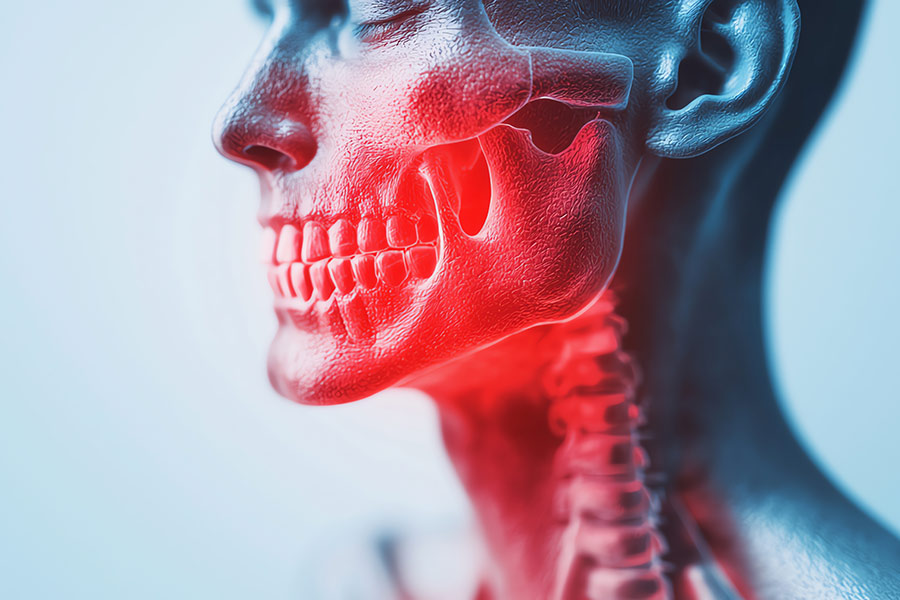
Painless and Controlled Jaw Joint (TMJ) Problems Treatment
Our goal in complaints such as jaw joint pain, clicking / locking and teeth clenching (bruxism) is to provide a rapid return to daily life with an accurate diagnosis, personalized planning and a comfortable treatment process.
30+ Years of Experience – Specialized Physician Staff – Modern Diagnosis and Planning
The temporomandibular joint ( TMJ) is a critical joint that connects the lower jaw to the skull and manages chewing/speech functions. Muscle-joint incompatibilities in this area can manifest itself with symptoms such as pain, limitation in jaw movements, clicking sound, head-neck pain and tooth wear. At Dentadent, our approach is to correctly identify the source of the problem and produce a permanent solution instead of suppressing the complaint.
Who is suitable for jaw joint problems? (Who should be evaluated?)
If you have one or more of the following complaints, an evaluation is recommended:
Clicking / snapping sound in the jaw joint
Difficulty opening the mouth, locking or slipping of the jaw
Pain and muscle fatigue when chewing
Jaw fatigue in the morning, teeth clenching / grinding (bruxism)
Recurrent head, neck and ear pain
Tooth wear, filling/crone fractures, sensitivity
Feeling of orthodontic irregularity or malocclusion
“ If jaw joint complaints are associated with closing problems Orthodontic Treatment can be planned together. For restorative needs in case of wear and sensitivity due to tooth clenching Restorative Dental Treatment evaluated.”
There is no single “standard solution” for jaw joint problems. At Dentadent, muscle-joint balance, bite relationship and clenching habits are evaluated together and night plate (splint), physiotherapy-supported approaches, restorative arrangements and orthodontic planning can be combined when necessary. The aim is to reduce pain, relieve joint movement and reduce the risk of recurrence of complaints.
Jaw joint treatment starts with a detailed analysis to correctly identify the source of the complaints. Then, a personalized plan is created according to the joint-muscle-closure relationship and in most cases, comfortable results are targeted with conservative (protective) methods.
1. Detailed examination and complaint analysis
2. Closure (occlusion) and joint function assessment
3. Night plaque / start of conservative treatment
4. Controls, necessary additional treatments and stabilization
Advantages of Jaw Joint Treatment
With properly planned jaw joint treatment, pain can be controlled, while chewing function and quality of life can be significantly improved.
Reduction in pain and muscle tension
Increased chewing and mouth opening comfort
Checking for wear due to tooth tightening
Support in reducing head and neck complaints
Maintaining closing balance
Comfortable and Safe Jaw Joint Treatment at Dentadent
At Dentadent, the priority in jaw joint problems is to progress gradually and in a controlled manner with scientific protocols, avoiding unnecessary procedures. In most patients, the first goal is to reduce complaints with conservative solutions (splint/plate-based protection and supportive methods). When necessary, more predictable results are achieved by planning together with different branches.
Expert Team in Jaw Joint Treatment
Jaw joint complaints may require the evaluation of closure (occlusion), muscle-joint balance and restorative needs together. At Dentadent, personalized and safe treatment processes are carried out with the joint approach of the relevant branches.
OUR EXPERT DENTISTS
DR. DT. NAMIK KEMAL AYHAN ORAL, DENTAL AND MAXILLOFACIAL SURGERY SPECIALIST
DR. DT. HÜSEYIN DEMIRKESEN ENDODONTICS SPECIALIST
DR. DT. BENAN OGUZ ORTHODONTICS SPECIALIST
DR. DT. MERVE SONGUL GUDUK PROSTHODONTICS SPECIALIST
SPEC. DT. CAN SAHIN RESTORATIVE DENTAL TREATMENT SPECIALIST
DR. DT. DILARA ZIYLAN PEDODONTICS SPECIALIST
DR. DT. ESIN ILKEM KURU ORAL, DENTAL AND MAXILLOFACIAL SURGERY SPECIALIST
DT. DR. BILGE KABACAOĞLU PERIODONTOLOGY AND GUM SURGERY SPECIALIST
DR. DT. CEVDET UTKU ORAL, DENTAL AND MAXILLOFACIAL SURGERY SPECIALIST
DR. MELIS BAL PERIODONTOLOGY AND GUM SURGERY SPECIALIST
DT. MURAT KARAKAS RESTORATIVE AND PROSTHODONTIC DENTIST
DR. DT. HANDE BACAK PEDODONTICS SPECIALIST
DR. DT. BUSRA KAYACIOGLU PROSTHODONTICS SPECIALIST
Book your appointment for the most suitable jaw joint treatment plan for you.
Make an appointment online
Consult a dentist
Free medical examination
Frequently Asked Questions About Jaw Joint Problems
Is a clicking sound from the jaw joint dangerous?
Not every click indicates a serious problem, but if it is accompanied by pain, locking or restricted movement, evaluation is necessary.
How long does the jaw joint treatment last?
The duration depends on the cause of the complaint and the planned treatment. With conservative treatment, the first relief can begin within a few weeks in most patients; the exact plan is determined after the examination.
Is it difficult to use a night splint?
No, no, no. Comfortable to use when prepared individually. Regular use supports the control of joint-muscle complaints by reducing the load due to clenching.
Does jaw joint pain cause ear pain?
Yes. Since the jaw joint and surrounding muscles are close to the ear area, the pain may be reflected as a feeling of pressure/pain in the ear.
Does orthodontics affect jaw joint problems?
In cases associated with closure disorders, orthodontic treatment can be included in the planning. In this context Orthodontic Treatment is evaluated together.
Is surgery necessary in advanced cases?
In rare cases, surgical evaluation may be required. This decision is made after examination, imaging and function analysis. In cases deemed necessary, planning is made with the relevant branch.
Hello 👋 Welcome to Dentadent. You can contact us via WhatsApp to book an appointment or get more information.